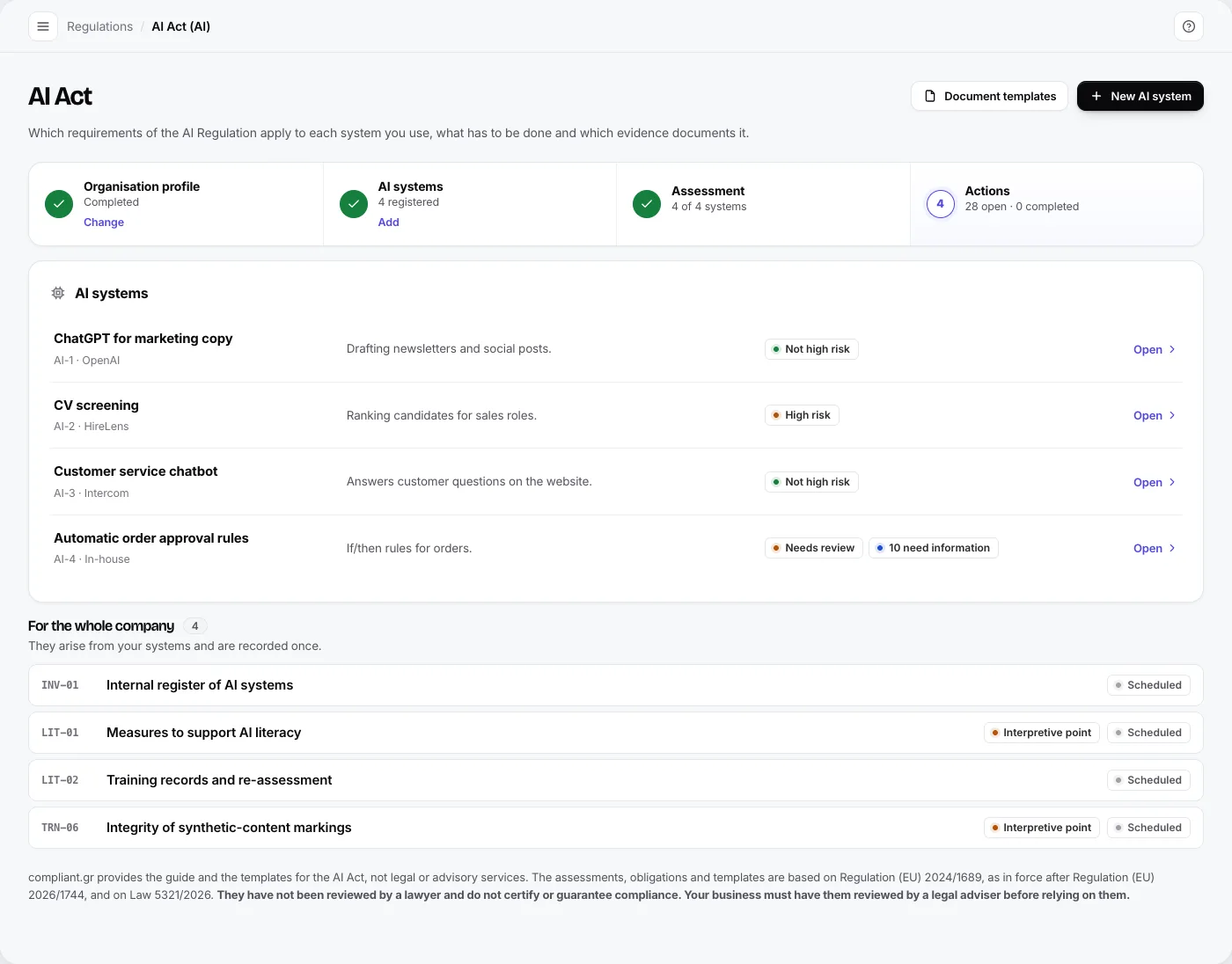
Almost every company already uses artificial intelligence: a ChatGPT for texts, a chatbot on the website, a tool that screens CVs. The AI Act does not ask whether you use AI, it asks for what purpose and with what effect on people. The new “AI Act” section in COMPLIANT.GR helps you answer that system by system.
A register for AI systems
Under “Compliance” there is a new register, “AI systems”. For each tool you record the provider, the purpose of use, the department, the company’s role (deployer, provider or other) and who it affects.
- Classification is by purpose, not by tool: the same tool used for marketing texts and for selecting candidates is two different cases.
- The register is an internal governance tool, not a national register you file anywhere.
Assessment in steps
First you fill in the company profile once. Then each system has its own short questionnaire, with plain questions and help at every step.
- The result shows whether the system is in scope, which risk category it falls in and what your role is.
- If you do not know an answer, you pick “I don’t know”. A system is never treated as low risk because a piece of information is missing: it stays “needs information”.
- If something changes, you run the assessment again and the history is kept.
- If a use looks like a prohibited practice, the page shows it with a separate warning.
Obligations become actions
Each obligation that follows appears as an action with an owner, a deadline and a status (planned, in progress, awaiting evidence, completed). You can link a document from your folder as evidence.
- Obligations that concern the whole company, such as staff training, are recorded once, however many systems trigger them.
- The calendar shows your own deadlines, not start dates that are not deadlines for you.
- There is no “compliance percentage”. You see how many actions are done, nothing more.
12 document templates
“Policies & procedures” gained 12 templates for AI: acceptable-use policy, training programme, screening for prohibited practices, human oversight, incident procedure, notice to employees and to people affected, transparency policy, vendor assessment, fundamental rights impact assessment, and more. You fill them in with your details, download them as Word or PDF, or save them to your documents.
What it is not
COMPLIANT.GR gives a guide and templates. It does not provide legal or advisory services, and the results are not a certification or an assurance of compliance. The assessments and templates have not been legally reviewed, and whatever comes out must be checked by your own legal adviser before you rely on it. The first time you open the section, this is stated in full and you accept it.
The “AI Act” section is available from the Business plan. See how it works, compare the plans or try the demo.